The Barrier Isn’t a Buzzword — It’s Your Skin’s Actual Defense System
“Skin barrier” has become one of those phrases that gets printed on bottles until it loses meaning. But the structure it refers to is real, measurable, and mechanically simple to understand.
Dermatologists often describe the outermost layer of skin — the stratum corneum — using a brick-and-mortar model. The “bricks” are corneocytes, flattened dead skin cells packed tightly together. The “mortar” is a mixture of lipids, primarily ceramides, cholesterol, and free fatty acids, arranged in organized layers between those cells.
This mortar isn’t decorative. It’s the physical barrier that keeps water inside your skin and keeps irritants, allergens, and microbes outside. When the ratio and structure of these lipids stay intact, skin looks plump, feels comfortable, and tolerates environmental stress. When the mortar erodes, the wall develops gaps — and that’s when problems start.
Why This Matters More Than Any Single Ingredient
Research in dermatology consistently points to barrier integrity as the variable that determines whether an active ingredient helps or harms. A retinoid or acid applied to an intact barrier behaves very differently than the same ingredient applied to compromised skin. Context — not concentration alone — determines the outcome.
Five Signs Your Barrier Is Compromised (and Why You Might Mistake Them for ‘Purging’)
One of the most common mix-ups in skincare is confusing barrier damage with “purging” — a temporary adjustment period some products cause. The two can look similar on the surface, which is exactly why so many people keep pushing a routine that’s actively hurting them.
Here are five signals worth taking seriously:
- Persistent tightness or stinging, especially right after cleansing, that doesn’t fade within minutes.
- Redness that spreads beyond the areas where you applied an active ingredient.
- A rough, flaky texture that appears in patches unrelated to your usual dry zones.
- Increased reactivity — products you’ve used for months suddenly feel irritating.
- Dullness paired with dehydration, where skin looks tired regardless of how much moisturizer you apply.
The key difference from purging: true purging is typically confined to areas where you’d normally break out, resolves within a few weeks, and doesn’t come with burning or stinging. Barrier disruption tends to be broader, longer-lasting, and accompanied by discomfort rather than just texture changes.
The Usual Suspects — Over-Exfoliation, Stacked Actives, and Harsh Cleansers
Barrier damage rarely comes from one dramatic mistake. It’s usually cumulative — small, well-intentioned decisions stacked on top of each other until the mortar between skin cells simply can’t keep up.
Three patterns show up again and again:
Over-cleansing. Surfactant-based cleansers, especially those with high foaming action, can strip lipids along with dirt and oil. Washing twice daily with a stripping formula — or double-cleansing every night regardless of makeup use — removes more mortar than skin can replenish overnight.
Stacked actives. Layering a retinoid, a vitamin C serum, an AHA toner, and a physical scrub within the same week (sometimes the same routine) asks skin to process multiple exfoliation and turnover signals simultaneously. Each ingredient may be reasonable alone; combined, they compound.
Harsh physical exfoliants. Scrubs with irregular, jagged particles create microscopic tears in the surface layer, which is a different mechanism of damage than chemical exfoliation but has a similar downstream effect on barrier function.
Why Multi-Acid Routines Backfire Faster Than You’d Expect
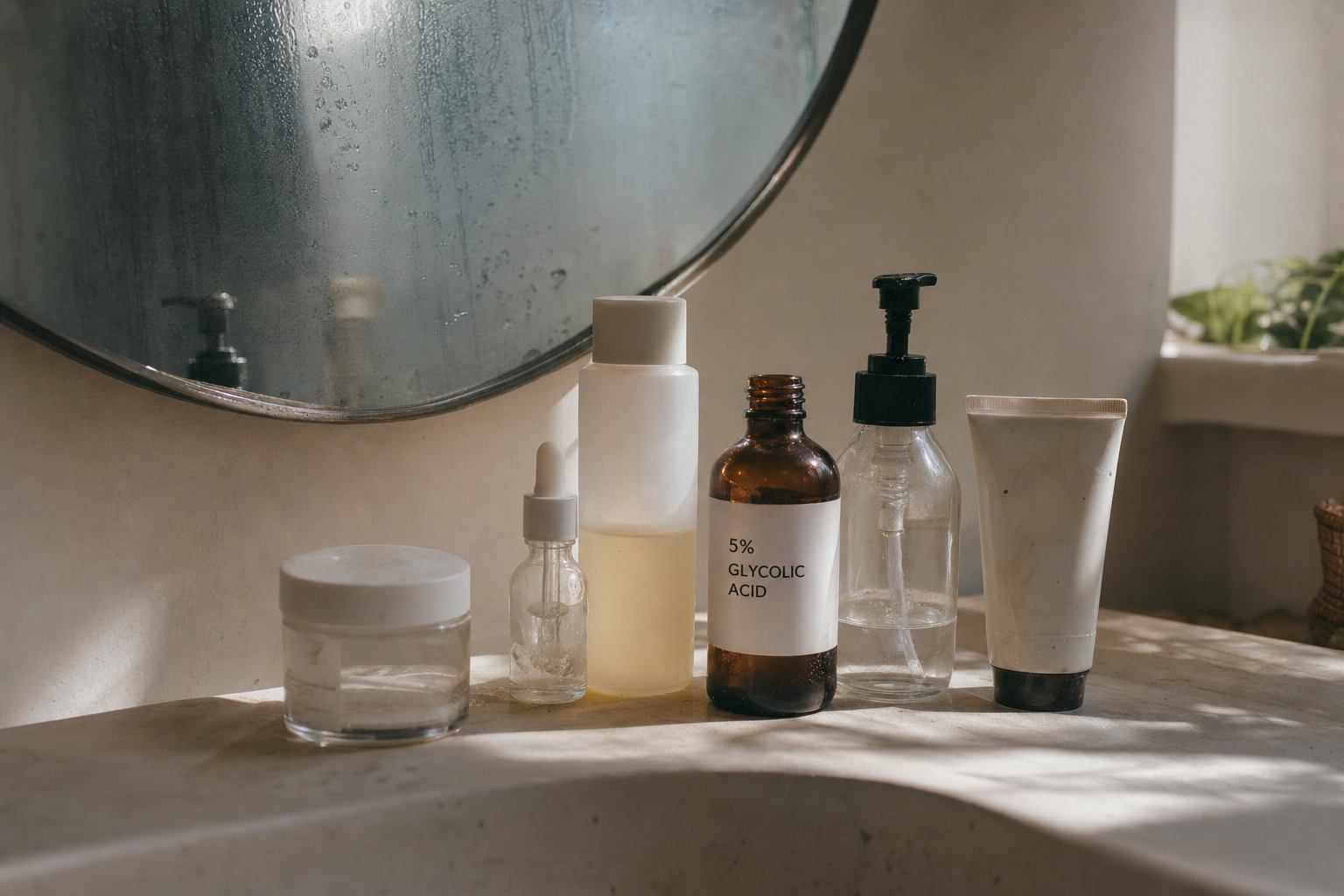
Multi-acid products — those combining glycolic, lactic, salicylic, and mandelic acids in one formula — have become popular precisely because they promise faster results. But research into skin’s turnover cycle suggests this speed comes at a cost.
The stratum corneum typically renews over roughly four weeks, though this varies by age and skin condition. Aggressive multi-acid use compresses this cycle, pushing corneocytes to shed before the lipid matrix around them has fully matured. The result is skin that looks initially smoother but becomes progressively more reactive, because the barrier never gets the time it needs to rebuild before the next exfoliation cycle begins.
The Rebuild Protocol — What to Strip Back and What to Add
The good news: barrier repair doesn’t require more products. In most cases, it requires fewer, gentler ones, used consistently.
Step 1 — Pause actives. Temporarily stop exfoliating acids, retinoids, and physical scrubs. This isn’t a permanent restriction — it’s a reset window, typically discussed in dermatology as lasting several weeks.
Step 2 — Switch to a low-foaming, pH-balanced cleanser. Look for formulas without sulfates like sodium lauryl sulfate, which are known to strip lipids efficiently — sometimes too efficiently.
Step 3 — Prioritize barrier-supportive moisturizers. These typically contain a combination of humectants (like glycerin or hyaluronic acid) to draw in water, and occlusives (like squalane or petrolatum) to seal it in — alongside lipids that mimic the skin’s own mortar.
Step 4 — Reintroduce actives slowly, one at a time. When you do return to exfoliants or retinoids, space them out, monitor for reactivity, and give skin time between introducing new ingredients.
Ceramides, Ceramide-Ratios, and Why Not All Barrier Creams Are Equal
Not every product labeled “barrier repair” delivers meaningfully. The distinction often comes down to ceramide ratios, not just ceramide presence.
Skin’s natural lipid mortar contains ceramides, cholesterol, and free fatty acids in an approximate ratio that dermatology research has associated with optimal barrier function — often cited in the general vicinity of 3:1:1. Formulations that include only ceramides, without the accompanying cholesterol and fatty acids, may not replicate this structure as effectively.
When evaluating a barrier cream, look for:
- Multiple ceramide types listed (not just a single “ceramide” ingredient)
- Cholesterol or phytosterols included alongside ceramides
- Fatty acids like linoleic acid in the formula
- A texture that feels occlusive enough to seal moisture without excessive fragrance or active ingredients that could reintroduce irritation

How Long Barrier Repair Actually Takes (Setting Realistic Expectations)
One of the most frustrating aspects of barrier repair is the timeline. Unlike a serum promising visible results in days, barrier rebuilding follows the biology of skin renewal — and that biology is slow by design.
Most dermatology-informed guidance suggests early improvements in comfort — less stinging, less tightness — within one to two weeks of simplifying a routine. However, full structural repair, meaning the lipid matrix rebuilding to a more stable ratio, is generally understood to take longer, often cited in the range of four to eight weeks, sometimes longer for chronically over-treated skin.
This matters because premature reintroduction of actives is one of the most common reasons barrier repair fails. Skin can look calm at the two-week mark while still being structurally fragile beneath the surface. Patience during this window isn’t a passive choice — it’s the intervention itself.

Summary: Rebuilding Is Subtraction, Not Addition
The stratum corneum’s brick-and-mortar structure explains why more products rarely solve barrier problems — and why fewer, better-chosen ones often do. Over-cleansing, stacked actives, and aggressive exfoliation erode the lipid mortar faster than skin can rebuild it, creating a cycle of sensitivity that’s easy to mistake for a routine that just needs “one more product” to fix.
The evidence points the other way. Simplifying, supporting the natural ceramide-cholesterol-fatty acid ratio, and respecting skin’s actual renewal timeline is what allows the wall to hold again.
If you’re not sure whether your current routine is helping or hurting your barrier, it can help to get a clearer picture before changing anything else.